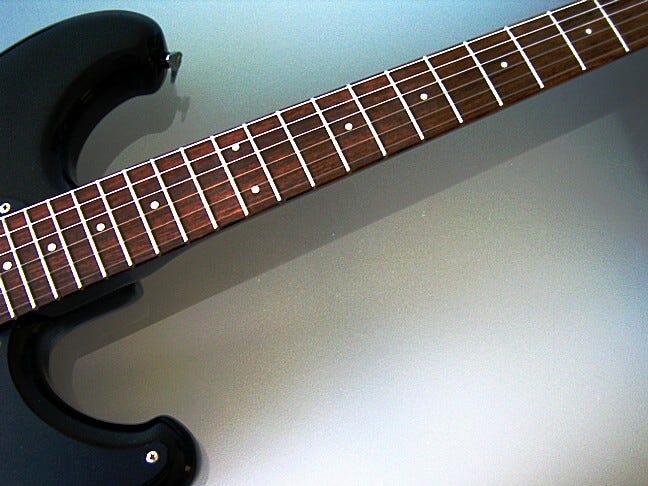
If you are more than an absolute beginner at the guitar, then you are probably aware of, and maybe even know a little about, those little dots on the neck of your instrument.
These dots are called fret markers, and they are there for a very good reason.
Fret markers are a form of inlay, and they serve as a visual guide so that the guitar player can quickly locate where he or she is on the neck at any time.
Or, to put it simply, they tell you which note you’re playing.
These markers have been added to virtually every guitar neck (with the exception of classical guitars) since at least the 1950s. The first Fenders had them, as did the Gibsons of the time.
But what is the history of these dots? Who invented them? And why are they in the positions they are?
The history of fret markers
As for the history of fret markers, it’s often said that they started with the electric guitar revolution in the 1950s. In fact, if you were to ask the big brands (Fender and Gibson), they would probably tell you the same.
While it may be true that fret markers became standard during this time, they weren’t invented by Leo Fender or Ted McCarty. We know that to be true because there are extant examples of much older guitars with fret markers. The oldest known guitar with dots was built around 1805, in fact. (Here’s a similar one from 1850).
Prior to this, guitars and other stringed instruments still featured inlay work on the fretboard, but it was strictly decoration and had no functional value.
So we can say that fret markers were in use as early as 1805 and became commonplace at least by the 1950s, but as to exactly who created them or when they were first used, well, that fact has been lost to history.
But there is another question to consider: Why are they located on certain frets and not others?
Why the standard pattern is standard
The standard pattern for the layout of fret markers is to put them on frets 3, 5, 7, 9, 12, 15, 17, 19, 21, and 24 (where available). But what was the reasoning behind making this the standard?
First, it makes sense to mark the 12th fret — usually done with double dots — because that indicates the octave: the same note, just higher. From there, the pattern just repeats itself, so it makes sense to mark it.
As for the reasoning behind the pattern itself, there is a bit of mystery here as well.
Some have pointed out that the 3rd, 5th, 7th, 9th, and 12th frets, when playing the E string, are all notes of the C major scale. While this makes for a convenient answer, it’s only almost true. The 9th fret on the E string is actually a C#, which of course is not part of the C major scale.
Others have suggested that the dots’ locations are a marriage of functionality and aesthetics. Because standard tuning is not symmetrical, no system of marking frets is going to work for every string. With that being the case, the tradition arose over time to mark certain frets (possibly based on the C major scale) but in a way that added “style points” to the guitar.
That being said, not all guitars follow the “standard” pattern. Russian-made guitars, gypsy-style guitars, and banjos all mark the 10th fret instead, which is a D on the low E string (which is in the C major scale), thus choosing functionality over visuals, if the second explanation above is to be believed.
Fret markers: form and function
Not all guitars use dots for fret markers, either. There is actually quite a lot of variation across guitar makers and styles. Other common styles include rectangles, zig zags, crosses, half moons, and my personal favorite, birds (on PRS Guitars).
Fret markers are a simple yet effective design on modern guitars. They help players orient themselves on the fretboard and find notes quickly, and they can add a bit of flair to make a guitar pop.
And even though we may not know the story of their creation with certainty, they are certainly helpful for players and, when designed well, add to the beauty of the instrument.
Comments
4 responses to “Why Do Guitars Have Fret Markers? It’s Kind of Complicated”
Hello there! This is kind of off topic but I need some
advice from an established blog. Is it very hard to set up
your own blog? I’m not very techincal but
I can figure things out pretty fast. I’m thinking about setting up my own but I’m not sure where to begin. Do
you have any tips or suggestions? Appreciate it
Hi! No, it’s not hard to set up a blog. There are a ton of free resources out there to help you get started from the technical side of things. WordPress is the most common platform people use. I’d start with this article: https://www.wpbeginner.com/start-a-wordpress-blog
I also have a paid course specifically dedicated to how to write engaging blog posts and overcome hurdles like writer’s block and impostor syndrome. You can check it out here: https://www.makebloggingsimple.com/aboutthecourse
Thanks for reaching out!
Howdy I am so happy I found your web site, I really found you by accident, while I was looking on Aol for
something else, Nonetheless I am here now and would just
like to say kudos for a tremendous post and a all round interesting blog (I also love the theme/design), I don’t have
time to read through it all at the minute but I have bookmarked it and also included your RSS feeds, so when I have time I will be back to read
a great deal more, Please do keep up the superb work.
There’s a quiet strength in your words that makes them linger long after reading.